
The KIDS Act Is Just as Unconstitutional as KOSA ... Just in Different Words
You've still skinned a cat no matter which way you go about it

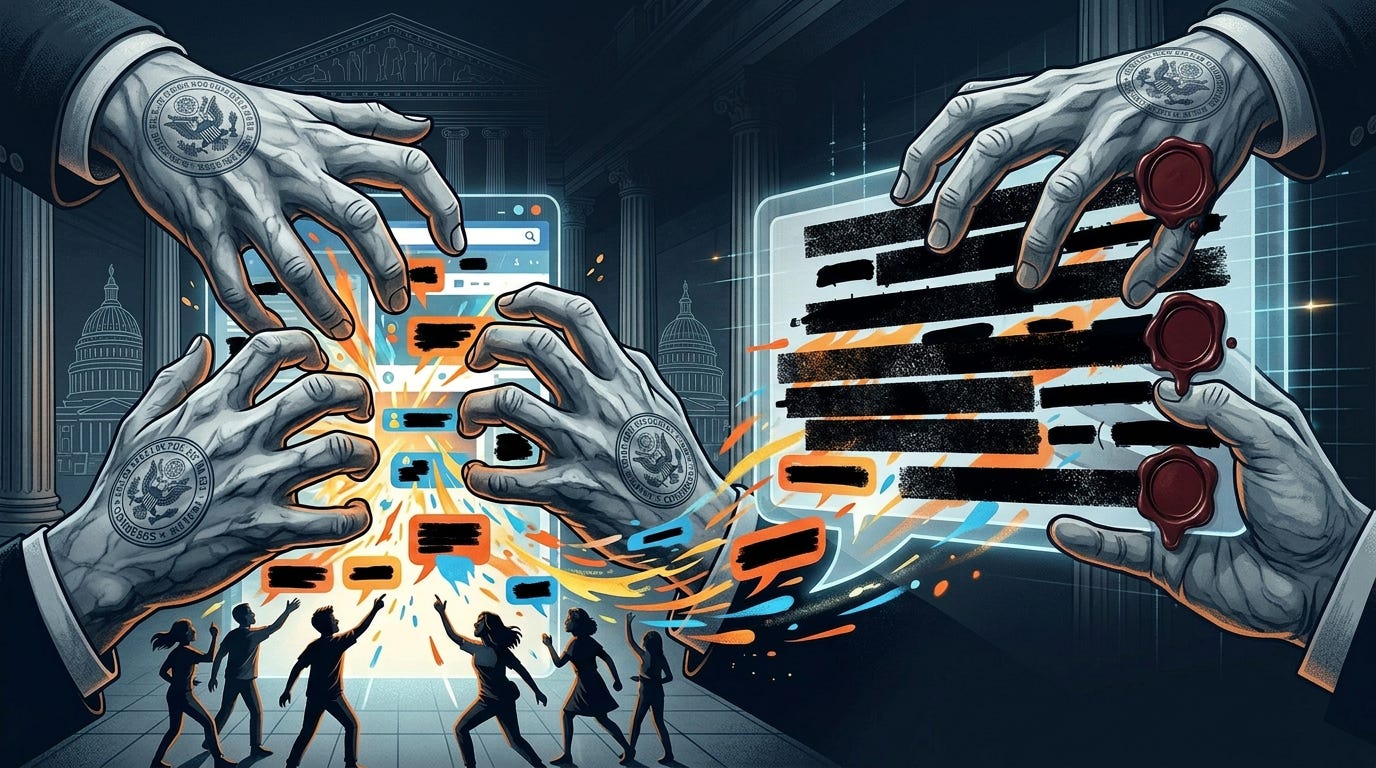
At the end of June, the House of Representatives passed the KIDS Act (HR 7757) — a package of ostensible online youth safety bills — in a semi-defiant response to the White House-backed Senate kids safety plan. The Senate plan packages two of its own censorship bills: the Kids Online Safety Act (KOSA) , which we have for years warned will lead to widespread censorship, and the App Store Accountability Act (ASAA), which would place mobile apps behind an age verification system for all users — together with some form of preemption of state AI regulation. To its credit, House leadership recognized that KOSA creates serious First Amendment problems, and members of the Energy and Commerce Committee attempted to avoid the glaring issues that KOSA’s sponsors have glibly dismissed for years.
Unfortunately, while the KIDS Act (which includes a reimagined version of KOSA) is certainly an improvement in some ways, it still poses serious threats to free expression. And like “some light treason,” “less unconstitutional” still lands you on the wrong side of the law.
Some of the provisions in the KIDS Act directly regulate speech while others create an incentive structure that makes censorship the only viable option. Here are some top-of-the-ticket free speech problems with the KIDS Act, though there are certainly more:
Kids Online Safety Act (House Mix)
House members and leadership were rightly concerned that Senate KOSA is a censorship bill, particularly when it comes to its core provision: the “duty of care” imposed on social media platforms to “prevent and mitigate” certain harms such as eating and anxiety disorders. I have written endlessly, from the time KOSA was first introduced in 2022, explaining that requiring speakers to anticipate and prevent harms from speech violates the First Amendment — forcing self-censorship simply because someone out in the world may be emotionally troubled and experience harm, no matter how unknowable or subjective.
The KIDS Act’s version of KOSA plots an emphatically different course, explicitly stating that it may not be interpreted to impose a duty of care. Instead, Section 213 requires platforms to “establish, implement, maintain, and enforce reasonable policies, practices, and procedures” to “address” a subset of KOSA’s enumerated harms: (1) threats of physical violence, (2) sexual exploitation and abuse, (3) distribution, sale, or use of drugs, tobacco, cannabis, alcohol, and gambling, and (4) financial harms “caused by deceptive practices.” Unfortunately, disclaiming the term “duty of care” doesn’t prevent this provision from effectively operating as one.
Different Words, Same Incentives
To be sure, this provision is less speech-restrictive than KOSA’s duty of care. It eliminates many of the subjective and individualized psychological harms that platforms cannot feasibly prevent. At first blush, the remaining harms all seem to involve either unprotected speech (e.g., severe threats of physical violence) or illicit conduct rather than speech (e.g., sexual exploitation and abuse). But a careful reader will note that the language isn’t limited to unprotected activity — “I’m going to kill you” is a commonly-used, colloquial “threat” that most times does not rise to the level of an unprotected “true threat.” But it may still trigger the KIDS Act anyway in the absence of limiting statutory language.
And even were there such a limitation, the provision would cause censorship by creating a broad risk mitigation requirement. Here, again, the KIDS Act might be an improvement over KOSA: Arguably, requiring platforms to “address” those harms is less demanding than requiring them to “prevent or mitigate” them: One might plausibly interpret this to allow for more error or partial measures from platforms. In theory, that means platforms could be less likely to restrict lawful speech.
But the essential problem remains: Nobody can really say what a platform must do to “address” these harms and avoid liability. Some measures may seem obvious: a policy banning the sale of illegal drugs, or prohibiting advertisers of age-restricted items from targeting minors. But beyond those, platforms will have the same perverse incentive to restrict speech that they would under KOSA. As I (joined by leading Internet and free speech scholars) wrote to the Senate back when KOSA was first introduced, it can be very difficult to discern — without individualized contextual investigation — whether online discussions of sensitive topics might cause harm, or instead, perhaps even reduce it:
[S]ome people—including many mental health and medical professionals—post about topics like eating disorders for the purpose of steering others away from unhealthy behaviors and encouraging them to seek help. By using the same keywords and hashtags as those who regrettably promote unhealthy behaviors, they “infiltrate” such content to provide a healthier perspective. Others post about their own struggles to seek out a community who can help them. As National Eating Disorders Association CEO Claire Mysko noted, “It’s very, very difficult to tease out what would fit under the category of toxic, pro-eating disorder content. . . . You don’t want to set it up as this is good and bad, demonizing the users who are posting this content.”
The same applies to conversations about use and abuse of illegal or age-restricted substances. Indeed, teens are highly likely to seek out help for such issues online; the ability to retain anonymity reduces fear of judgment and provides a safe space where they can speak candidly about their issues. But from a platform’s perspective, allowing minors to discuss drug or alcohol use would create massive legal risks. If an enforcer, perhaps responding to a visible tragedy, decides that a failure must be indicative of inadequate policies and procedures, the platform will face the high cost of defending against an enforcement action, and ultimately risk potentially massive penalties.
The safe bet, from a platform’s perspective, is just as it is under Senate KOSA: cordon off youth from any content or conversation that touches on an issue that could plausibly be alleged to lead to any enumerated harm.
Worse, this risk mitigation regime will also lead to censorship of core political speech. Minors have a legitimate, constitutionally protected interest in discussing many issues relating to alcohol, tobacco, and other substances. They might wish to read and engage on social and political topics such as legal status, age restrictions, law enforcement activity, and many others. But the uncertainty of what it means to “address” the distribution or use of substances is likely to result in youth being banished from reading or discussing them online.
Political Abuse Still Looms Large
The KIDS Act would be enforced by the Federal Trade Commission (FTC) under its “unfair or deceptive trade practices” powers, and by state attorneys general who would be empowered to bring enforcement suits on behalf of citizens of their states. This makes the bill even more likely to be abused than KOSA, which in current form limits enforcement of the duty of care to the FTC, preventing shameless state attorneys general from using it to grandstand for political and culture war purposes.
It’s easy to see where this could go sideways. Consider the requirement to address “sexual exploitation and abuse.” Those are labels that some — including potential enforcers — have applied even to simply providing any information to youth about LGBTQ issues generally. So to the provision of gender-affirming care. In 2022, Texas Attorney General Ken Paxton issued a formal opinion declaring that providing gender-affirming care to minors constitutes “child abuse.” Then-FTC Commissioner Andrew Ferguson promised the White House he’d “Fight back against the trans agenda” if picked as Trump’s second FTC Chair.
And he has made good on that promise: Just recently the FTC filed a problematic lawsuit against the World Professional Association for Transgender Health (WPATH), alleging that it misled parents about the safety and necessity of pediatric gender-affirming treatments. It does not take much imagination to predict those same parties arguing that “addressing sexual exploitation and abuse” entails restricting, in some way, minors’ access to such content. Such an claim need not even be ultimately victorious — the burden of the investigatory process itself can be wielded to pressure platforms into reducing the availability or visibility of disfavored content.
A state attorney general might similarly argue that violent, hateful yet constitutionally protected content is either itself a “threat,” or that it simply contributes to an environment that encourages or perpetuates threats and acts of violence — and launch a costly, coercive lawsuit against platforms for not “addressing” (i.e., censoring) it.
Despite the KIDS Act’s attempt to narrow the categories of harm, avenues for abuse remain wide open. And if history has taught us anything, it is that they will inevitably be utilized.
Age Verification
The KIDS Act, like its Senate counterpart, avoids explicitly mandating age verification and includes a rule of construction prohibiting any interpretation that it imposes such a requirement. And for good reason: The courts have long held that requiring users to identify themselves before accessing protected material, or speaking, chills speech in violation of the First Amendment. The Supreme Court’s recent (and wrong) decision upholding Texas’ pornography age verification law doesn’t mitigate the First Amendment problem here. The Court’s reasoning relied on the established precedent that some sexually explicit material is not constitutionally protected for minors, even though it is for adults. But social media is a general forum for communication, and the vast majority of content it contains is constitutionally protected for adults and minors alike.
Again, one must look past the protestations and disclaimers, and examine the practical realities. Many of the KIDS Acts’ requirements are triggered when a platform knows or should have known that a user is under the age of 17. “Should have known” is a very low standard, far lower than “actual knowledge,” which requires direct awareness or willful blindness. It effectively asks whether a reasonable person would have known, given the circumstances, that a user is a minor. Short of a user admitting (perhaps by inputting their real birthdate) that they are a minor, what does this mean, exactly?
Supporters have suggested various unsatisfying answers to this question. Some point to analysis of a user’s “friends” or “follows.” But is that a consistently meaningful indicator? An adult who works with youth and uses their account primarily for related communication might have a friend list consisting mostly of minors while a minor who primarily uses a platform to keep up with family might have one consisting mostly of adults. Others suggest that contextual information about what interests a user expresses or the manner of their posts can put a platform on notice. But the interests of a 15-year-old and an 18-year-old will in many cases look relatively similar. And I don’t have to tell you how many adults post like a 13-year-old version of themselves. Still others point to the fact that platforms already estimate ages for purposes of advertising. While true in some cases, a platform bears relatively little risk if their advertising demographic estimations are wrong; those estimations are simply not designed for compliance with a regulatory regime that carries steep penalties for errors.
Those penalties, once again, leave platforms only one clear path to insulate themselves from liability: collect identity information from all users so that they have evidence that their assessment of any particular user’s age is reasonable and based on sufficient diligence.
All users will end up losing their fundamental right to speak anonymously online. Some will forgo online discussion of sensitive or controversial topics and unpopular views. Others will find themselves vulnerable to retribution if their speech displeases the government or other powerful figures. And criminals will have an even richer target of sensitive personal information to steal, undermining the privacy and security of all users. The chill from this “papers, please” regime for online speech risks undoing much of the Internet’s speech-democratizing effects.
A Prior Restraint on Gaming Squads
While the KIDS Act focuses primarily on social media platforms, it also nerfs the First Amendment for gamers. Video games are themselves the protected speech of their creators, but they also often serve as a forum for user speech. In Roblox, for example, “users [can] create their own worlds and experiences, visit the numerous experiences created in the game by other users … and interact with friends or other users in the game.” All of those things are user expression (which is why claims based on them have been dismissed under Section 230).
The Safer GAMING Act, contained in Title III of the KIDS Act, requires platforms to prevent, by default, any user it knows, or should know, is a minor from communicating with any other user. This provision apparently applies to in-game chat as well as other, private messaging — and that limitation may only be removed by a parent.
It’s actually a pretty breathtaking proposition, if you think about it: minors are banned entirely, by default, from communicating with any other user in any way across an entire forum.
The Supreme Court has disapproved of blanket, government-imposed bans from online forums. North Carolina law prohibited registered sex offenders from using any “social networking” website. Holding that law unconstitutional, the Court concluded: “In sum, to foreclose access to social media altogether is to prevent the user from engaging in the legitimate exercise of First Amendment rights. It is unsettling to suggest that only a limited set of websites can be used even by persons who have completed their sentences.”
The First Amendment does not simply disappear whenever a child wishes to speak. Minors have significant First Amendment rights, which Congress is no more free to disregard than those of adults. When the Supreme Court struck down California’s ban on the sale of violent video games to minors in Brown v. Entertainment Merchants Association, it fragged the idea that “the state has the power to prevent children from hearing or saying anything without their parents’ prior consent.”
Permitting parents to override the default, government-imposed censorship does not save this provision. In Brown, as here, a parent could effectively “change the setting” by purchasing such games for their children. But the Court rejected California’s claim that it was merely aiding parental authority: “Such laws do not enforce parental authority over children’s speech and religion; they impose governmental authority, subject only to a parental veto.”
These first principles apply with equal force here, and doom the Safer GAMING Act — even if the courts were to rule that it is content-neutral (in contrast with Brown, where the law targeted certain ideas within games). Even a content-neutral time, place, and manner restriction must leave open “ample alternative channels for communication.” A total ban on any communication with other users obviously fails to do that. This is particularly so in the case of in-game chat, with its focused and limited context, timing, and participant scope, i.e., chatting with other players about the game being played contemporaneously. As courts have recognized, alternative channels of communication are not “ample” when they do not permit a speaker to reach their intended audience — and the Safer GAMING Act allows for no meaningful alternative to its government-imposed silence-by-default.
Making Chatbots Chattier (The Government’s Way)
It seems that all legislation is now somehow AI legislation, so it will not surprise you to learn that chatbots got their own title in the KIDS Act. Title IV contains the SAFE BOTs Act which — as you might have already guessed — imposes a number of requirements on what chatbots cannot say, and what they must say. These requirements are similarly triggered when an AI company knows, or should know, that a user is a minor — extending the age verification incentives to AI chatbots as well. If you’re thinking that it’s starting to seem like you can’t do anything on a computer without identifying yourself, you’re not wrong.
AI chatbots are inherently expressive. Their output—guided by the expressive choices of their creators and users—communicates ideas, whether in a poem, a blog post, or an answer to a research question. Those outputs, as I have explained (alongside my colleagues), are speech no less entitled to First Amendment protection than expression created with any other tool. While, mercifully, we do not yet have to tangle with whether The Machines themselves have speech rights, developers and users surely do. Developers engage in First Amendment activity when they program and train (and re-train) their chatbots to deliver the developer’s desired types of outputs in specific forms, styles, and tones—and to not deliver certain content. Users engage in a collaborative effort with the chatbot, directing the topic and other parameters to obtain the information, writing, image, etc. that they are looking for. That chatbot output is dependent on these expressive choices: Change any one of them and you get a meaningfully different response. This expressiveness imbues it with the same First Amendment protection as the choices that directly created it.
If that (abbreviated, to be sure) explanation doesn’t convince you, consider the alternative. If chatbot output isn’t protected by the First Amendment, there is little standing in the way of chatbots being limited to government-approved information and messages. Absent First Amendment protection, what prevents Congress from passing a law prohibiting chatbots from saying that Joe Biden won the 2020 election? Or forcing them to convey the view that “neither Bill nor Hillary Clinton ever met Jeffrey Epstein?” AI is playing a rapidly increasing role in how we communicate with each other, and how we seek and retrieve information about the world around us. If courts said chatbot output isn’t protected speech, government would gain unthinkable power to control how we speak, and what information we are allowed to obtain.
We see this happening already. Just last week, the FTC put out a request for comment on its proposed policy position deeming it an “unfair or deceptive” practice for an AI company to “distort their systems’ outputs to achieve undisclosed ideological objectives” when consumers expect “objectivity and accuracy.” Of course, this means that the FTC gets to decide what is “objective and accurate,” and what kinds of information is an “ideological distortion.” The thought alone should chill you to the bone, no matter where you fall on the ideological spectrum (remember, that power will one day be held by those very much not aligned with your views).
The KIDS Act doesn’t dive quite as headfirst into the dystopia of government-established orthodoxy, but it doesn’t not go down that road. The SAFE BOTs Act requires that chatbots refrain from outputting some ideas, and compels them to output others—which is only constitutional if the First Amendment magically disappears when AI is involved.
When it comes to what chatbots must say, SAFE BOTs requires that after three hours of “continuous” use, a chatbot must “advise [the user] to take a break.” You don’t know my life! Whether or not a particular user should “take a break” is an entirely subjective matter that is within neither the purview nor the authority of the government. Imagine if Congress passed a law requiring publishers of popular books to insert a page after each chapter saying “you should stop reading for a while.” Nobody would, for one second, accept that such compelled speech (see here for a more detailed explanation of when compelled speech is permitted) is constitutional. This is no different.
SAFE BOTs also limits the types of content chatbots can provide to users. It replicates (House) KOSA’s “reasonable policies to address” requirement, creating the same problems. But where KOSA (unsuccessfully) tried to mitigate the problem by allowing platforms to provide information in response to user requests, SAFE BOTs’ rule of construction only allows chatbots to provide information “regarding the prevention or mitigation” of the enumerated harms—posing an even more demonstrative threat to users’ expressive rights.
The bill also prohibits a chatbot from conveying a response that “states … that the chatbot is a licensed professional (unless such statement is true).” That restriction goes far beyond any conceivable legitimate concerns that a chatbot might convince an unreasonable person that it is literally a doctor. It might (might) be one thing to require such a disclaimer in response to a user seeking actual medical advice (but again, even that is debatable). But imagine the following prompt: “I am going to the doctor today and would like to practice how I will communicate my concern. Take the role of a skeptical doctor who doesn’t believe their patients.” The user clearly knows that the chatbot isn’t a licensed medical professional. Yet SAFE BOTs would prohibit the chatbot from rehearsing the conversation with the user, depriving them of potentially helpful insight in how to communicate with their actual doctor. Whatever concerns one might have about chatbots misleading users (though it is doubtful that a reasonable user would believe that a chatbot is a licensed professional in any circumstance), this prohibition is clearly far too broad to survive First Amendment scrutiny.
—
These are just a few of the problems with the KIDS Act. Several remain, including COPPA 2.0, which we’ve written about before. While it’s commendable that members of Congress saw the glaring First Amendment issues with Senate KOSA’s duty of care, the KIDS Act makes a semantic distinction but little constitutional difference.